
Awards FAQs
Can I nominate someone for an award?
We no longer require nominations.
What happens when I apply for an award?
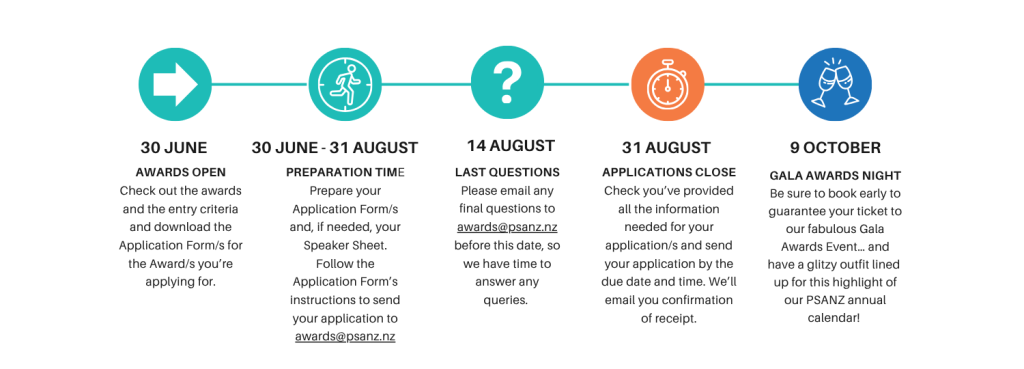
- Download the application form from the appropriate award page.
- Save the Application Form to your computer and add your name at the end of the file name.
- Send an email to awards@psanz.nz letting us know which award you will be applying for.
- We will set up an online folder for you where you can upload any other required documents when you have completed them.
- Want to make changes to your Application? No problem: access your folder before the closing date and make changes in the document/s, or delete the old file/s and upload the new one/s
- Email the application form to awards@psanz.nz when your application is complete
Powerfully succinct self-selling is crucial for professionals speaking in today’s world. Please only send the information we ask for.
Who is eligible for a given award?
Our Awards are linked to our membership categories, and the eligibility criteria are listed on the web page for each award.
To maintain the integrity of our awards, the Awards Convenor is not eligible to apply for any awards, and if they intend to apply in a given year, they must step down before applications open. Other Board members may apply for any relevant award/s, provided they are not involved in operational awards processes.
How many awards can I apply for?
You can apply for up to TWO awards, provided you meet the criteria. Remember that past winners must stand down for two years before they can be apply again for that award. For example if you won in 2025 – you would not apply for the following 2 years (2026 and 2027) and apply in the third year 2028.
What do I need to know about the Application form?
As soon as you download the application form read through to see what information you need to prepare. The form has suggested content for you to create under each heading.
The main questions people ask are, “Do I have to make the application form into a beautiful branded document?” and “ Will I be penalised if I submit the form just as it is, a simple word document?”
Answers: No and No. Please be reassured that you do NOT need to glamourise your application form! The judges are strictly focused on your content. You only need to send us that form in a clean and tidy state – and then you can focus your creative energies on preparing your Speaker Sheet and the links in your Application Form and Speaker Sheet that will point the judges to more information about you and your work!
What are the judges looking for?
The judges want to know if you are the one who deserves to win this award. This means that:
- the links and testimonials in your Application Form need to show your excellence and professionalism, and
- your Speaker Sheet would make a client or bureau want to hire you on seeing it!
What is a ‘Speaker Sheet’?
A Speaker Sheet is a compelling and unique showcase of your expertise and originality. Traditionally, this has been a 1-2 page information sheet downloadable from your website that sells you to clients and bureaus thinking of engaging you for their event. An emerging trend is for these to be a set of 3-5 impressive PowerPoint slides that provide great photographic evidence of your professionalism.
Not all awards require a Speaker Sheet, but if you have one, you can submit it even if it’s not required.
You may submit a Speaker Sheet as a PDF with EITHER no more than two sides of A4 content OR a maximum of 6 PowerPoint slides.
Would a client or agent hire you on seeing your Speaker sheet? Make sure you prepare a brilliant one! Search for the term ‘Speaker Sheet’ online and you will find many great examples, while Canva has a great One Sheet template.
What do we mean by ‘speaking’?
Professional speakers associations around the world recognise the following business models for paid speaking:
- Speaking or Mcing for a fee
- Speaking for free while selling things like books, programmes or coaching from the stage
- Running your own events, with fees measured as revenue, not profit
- Training workshops or courses
- Paid webinars that generate speaking-related income.
Why do I have to produce financial information?
The business models above list how professional speakers generate income for their businesses. That’s how we earn our living: PSANZ and our sister associations worldwide are all about helping people with a message run a successful speaking business. Successful business people track all their financial metrics. So it’s good to start doing that from the outset of your speaking career because, for the big awards, you need to show that you can bring in big money!
How can you “show us the money”? You can ask your accountant to verify your speaking income using the Statutory Declaration Form below, or you can sign that form yourself. You can also send us a list of invoices if you wish.
Statutory Declaration Form (PDF)
How big is the money? Click here to check out the income threshold for becoming A CSP or Certified Speaking Professional in Australia and New Zealand.
Why do I have to provide testimonials?
Testimonials from thrilled clients and attendees are the most genuine tributes to your speaking skills. These can be in written or video format. We ask for contact details from three of your delighted clients so we can speak to them in person.
What do we mean by “professionalism”?
As the national association of speaking professionals, including speakers, trainers, entertainers and MCs in New Zealand, our annual PSANZ awards recognise and celebrate our members’ professionalism in terms of their:
- exemplification of the ‘Four Es’ of professional speaking: Expertise, Eloquence, Enterprise, Ethics
- observance of PSANZ’s four values
- achievements in the speaking profession
- outstanding expertise and professionalism for our full members, life members and CSPs
- Ability to come across warmly on screen: video is becoming increasingly important as a means of delivering – and marketing – your services
- engagement with live and screen audiences
- adaptability to the challenges of speaking in the 21st century, highlighted by and going beyond.
That’s why we ask you to describe your service to PSANZ and the wider industry in your Application Form – it’s in the spirit of Cavett Robert, founder of the world’s first professional speaking association.
When do we give or withhold awards?
Here’s how we maintain our awards’ integrity and prestige:
- We may decide not to present an award(s) in a given year. Pandemics and other crises aside, judges may refrain from granting one or more awards if, in their expert opinion, none of the applications exemplified the standards we expect
- If there is only one applicant for an award, the Awards Convenor may submit it to the judges, reminding them that the application must still meet the winning standard
- Past winners of other awards have a two-year stand-down period before they can reapply for the same award, though they may apply for different awards during that period. For example if you won in 2025 – you would not apply for the following 2 years (2026 and 2027) and apply in the third year 2028.
- The David Nottage Legacy Award is a once in a lifetime award. Those who have received the David Nottage Legacy Prize as the prize for another award in previous years are not eligilble to win the award again.
We wish you all the best with your application.
See all awards
Get onto it early, so everyone has enough time to do a great job!